
The Great Dying:
Why Earth's Biggest Extinction Happened


Imagine a world where nearly everything in the ocean suddenly died.
This really happened about 252 million years ago at the end of the Permian period.
Scientists call it “The Great Dying" because it was the worst extinction in Earth's history - even worse than when the dinosaurs died out.
Now, researchers think they've finally figured out why it happened.

Back then, all the continents were stuck together in one giant landmass called Pangaea, surrounded by a single global ocean.
The climate was generally warm, with ocean conditions similar to modern times.
Then, disaster began when enormous volcanoes in Siberia started erupting.
They erupted continuously for nearly a million years.
These weren't ordinary volcanoes.
They were supervolcanoes capable of changing the entire planet's atmosphere.

Scientists used computer models to understand what happened next.
They found that as the planet warmed, the oceans changed in dangerous ways.
The water temperature near the equator rose by about 10°C (20°F).
Even worse, the oceans lost about 80% of their oxygen.
Half of the seafloor, especially in deep areas, became completely oxygen-free.
This created huge dead zones.

To understand how this affected sea creatures, scientists studied 61 modern marine species including fish, crabs, corals and sharks.
They used this information because modern animals breathe and handle heat similarly to Permian animals.
The results showed most creatures couldn't survive where they lived.
Creatures had to move—or die.

Here's the surprising part: while scientists thought tropical species would suffer most, the model showed polar creatures were actually hardest hit.
Here's why: tropical species were already adapted to warm, low-oxygen water.
When their habitat became unbearable, they could migrate toward cooler areas.
But animals living in cold polar waters had nowhere to go when their oxygen-rich, chilly habitat disappeared completely.
Their entire ecosystem vanished from the planet.
Fossil evidence proves this really happened.
When scientists examined fossils from before and after the extinction, they saw exactly what the model predicted.
More species died near the poles than near the equator.
This match between the model and fossils gives scientists confidence they've found the main cause of the extinction.
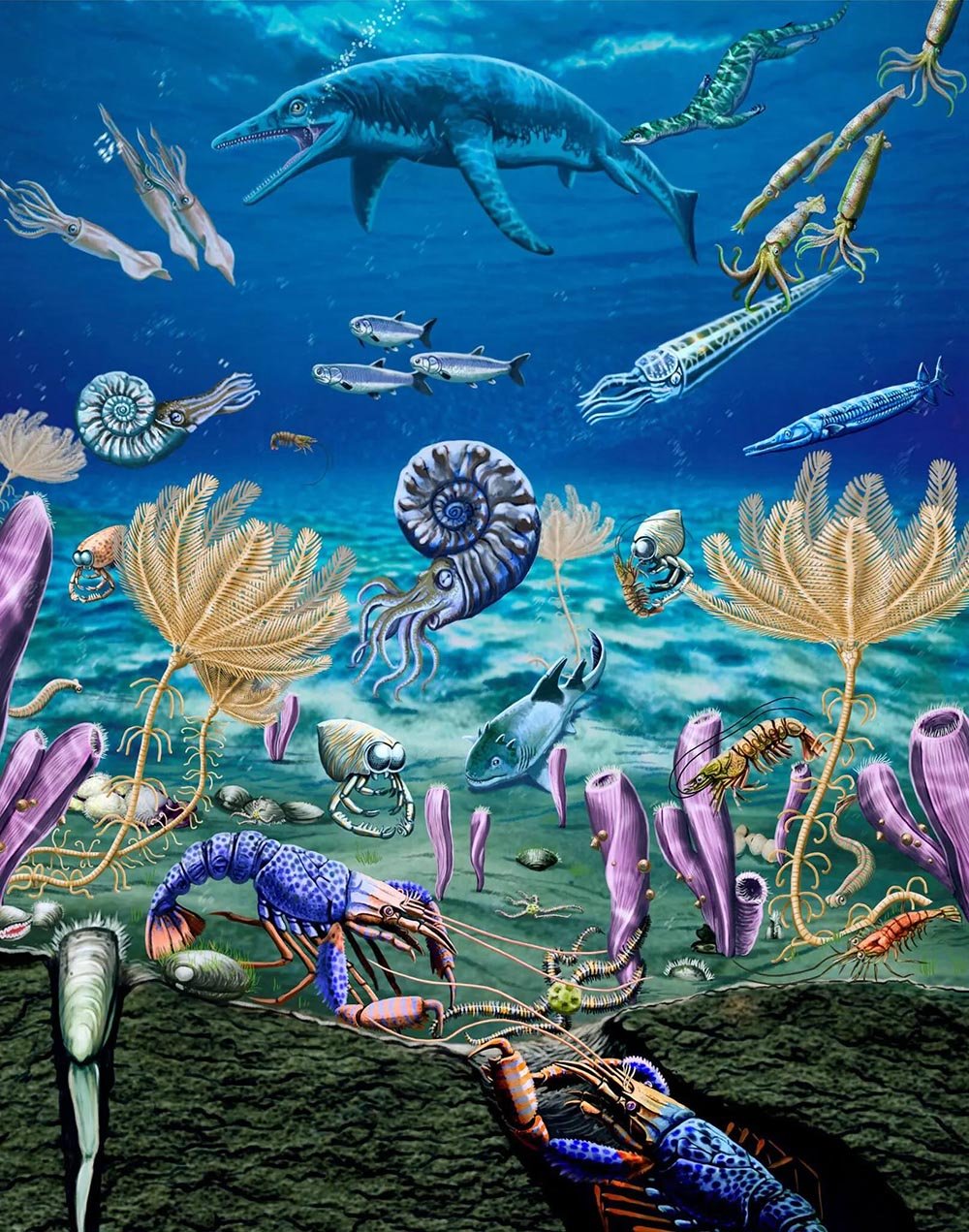
The key was how warming affected different animals.
Warmer water holds less oxygen, but also makes animals' bodies work faster, so they need more oxygen.
Tropical creatures were already used to warm, low-oxygen water.
But polar animals, needing lots of oxygen and cool temperatures, were trapped with nowhere to go when their environment vanished.

This discovery helps explain why the Permian extinction was so much more severe than the dinosaur extinction 65 million years ago.
The asteroid that killed the dinosaurs caused immediate devastation.
But the Permian disaster unfolded more slowly but affected the entire ocean ecosystem through combined temperature and oxygen stresses.
The study also provides crucial insights for understanding modern climate change.
Today's oceans are warming and losing oxygen at alarming rates, just like during the Permian crisis.
By showing how marine ecosystems responded to ancient climate shifts, this research helps predict which species might be most at risk today.
The lesson from Earth's deepest past is clear: when oceans change too quickly, marine life pays the ultimate price.

► COMPREHENSION QUESTIONS
— please answer with complete sentences
What was Earth's land like during the Permian period?
How bad was the Great Dying?
What natural event started the mass extinction?
Where did this occur?
How did the oceans change during the extinction?
Why did scientists study modern marine animals?
Where did tropical animals move as the ocean warmed?
Where did arctic (polar) animals move as the ocean warmed?
How do we know the scientists' model is correct?
Why was this extinction worse than when the dinosaurs died?
If climate change today causes temperatures to rise, which animals might be most affected in the near future?
ABCD (Above & Beyond the Call of Duty) — the only way to get to 50/50 (A+); you may need the points if you’ve dropped points above.
Watch the short video below.
Write two new questions and answer them!