
HALEAKALĀ

• Read •
HALEAKALĀ
A Park Like No Other
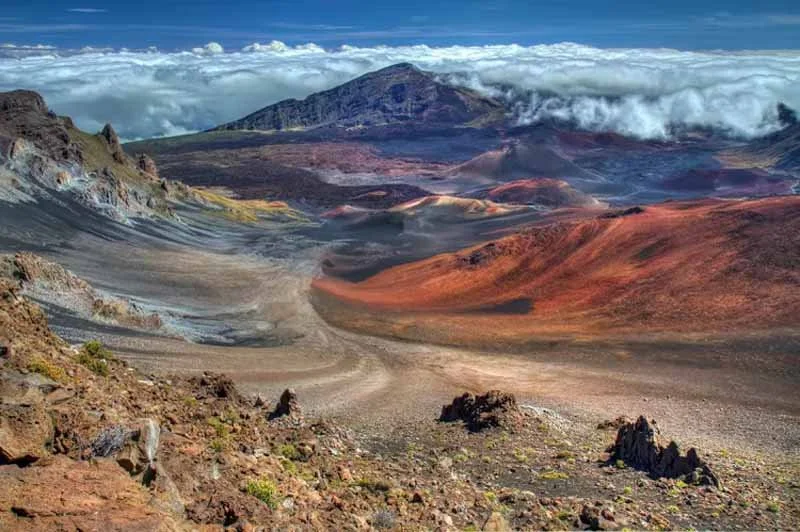
Haleakalā National Park sits on the southeastern side of Maui, the second-largest island in the Hawaiian Island chain.
The park protects about 33,265 acres of wild volcanic landscape — mountains, lava fields, coastal cliffs, and rain forests packed with rare plants and animals found nowhere else on Earth.
From the coast, the land rises sharply to 10,023 feet at the summit of the shield volcano Haleakalā.
In just a few miles, you go from sea level to the top of a mountain that feels like another planet.
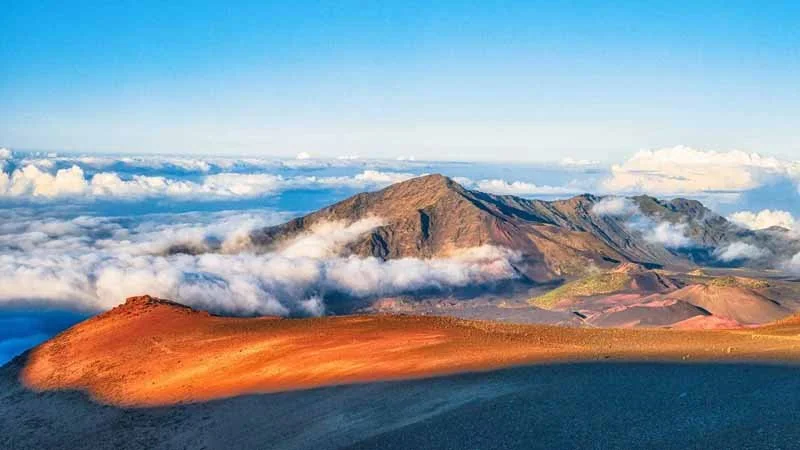
The park was first established in 1916 as part of Hawai’i National Park, then renamed in 1960, and later designated a Biosphere Reserve in 1980.
The northern and eastern slopes are among the richest botanical regions in all of Hawai’i, sheltering some of the world’s rarest birds, plants, and invertebrates.
Born from a Hot Spot
To understand Haleakalā, you need to understand how the Hawaiian Islands formed in the first place — and it has nothing to do with two tectonic plates crashing together.
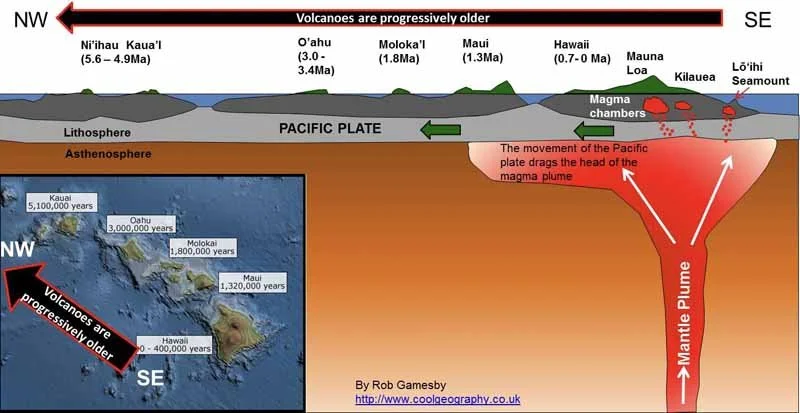
Instead, Hawai’i sits on top of a hot spot.
A hot spot is a plume of superheated rock that wells up from deep inside the Earth, melts through the crust, and builds volcanoes on the ocean floor.
Over millions of years, layer after layer of lava piles up until the volcano breaks the ocean surface and becomes an island.
• Figure 1
Here is the twist: the hot spot stays in one place, but the Pacific Plate — the enormous slab of ocean floor that Hawai’i sits on — keeps drifting slowly to the northwest.
As the plate moves, it carries each volcano away from the hot spot.
A new volcano starts building in the place the old one just left.
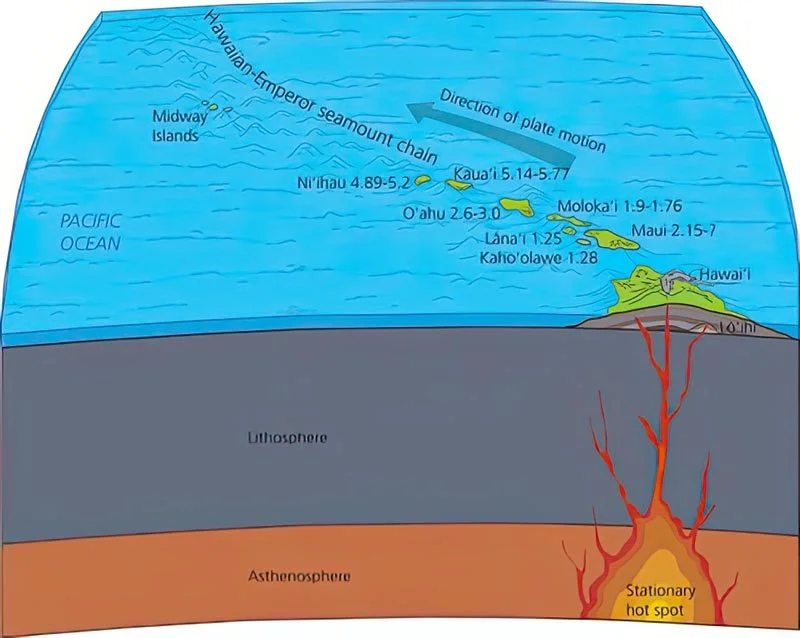
This is why the Hawaiian Islands form a long chain, with the oldest islands to the northwest and the youngest (and most volcanically active) to the southeast.
Maui is the second youngest of the seven main Hawaiian Islands.
Eventually, every Hawaiian volcano gets pulled far enough from the hot spot that it stops erupting, erosion tears it down, and it slowly sinks back into the sea.
That is the fate waiting for Haleakalā — though not for a very long time.
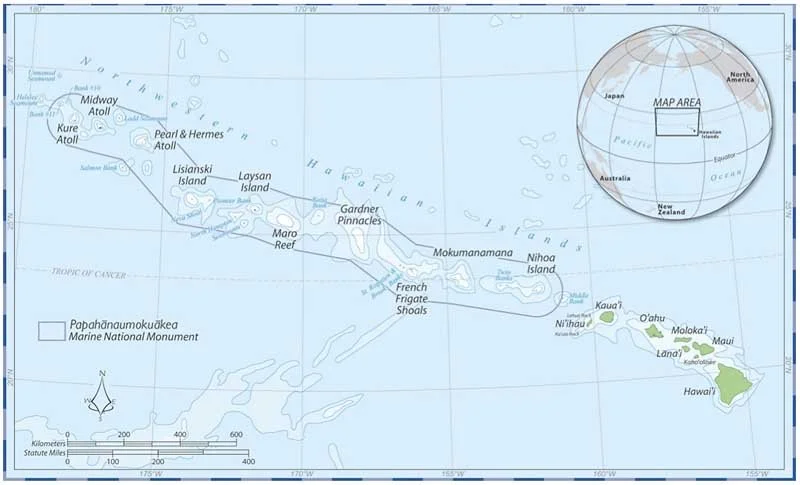
• Hawaiian archipelago
A Shield Volcano
Haleakalā is a shield volcano, and all Hawaiian volcanoes share this shape.
The name comes from the way they look: long, broad, and gently curved, like a warrior’s shield laid flat on the ground.
Shield volcanoes form because Hawaiian lava is relatively fluid. Instead of exploding violently, it pours out in thin flows that spread far and wide, building up layer by thin layer over millions of years.
Haleakalā measures about 20 miles in circumference and makes up three-quarters of the entire island of Maui.
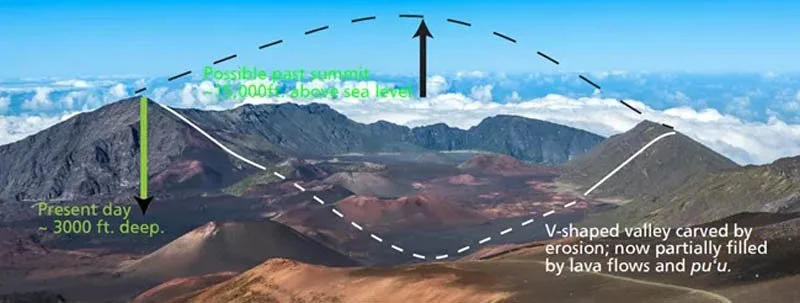
The summit currently stands at 10,023 feet, but geologists believe it once reached 15,000 feet above sea level.
Erosion and the weight of the volcano itself slowly sinking into Earth’s crust have worn it down over time. Even so, when you measure from the ocean floor, Haleakalā rises 28,000 feet — making it the third-tallest mountain on Earth.
Geologists divide Hawaiian volcano growth into four stages: pre-shield, shield, post-shield, and rejuvenated.
Haleakalā is thought to be in the post-shield stage, meaning the most intense volcanic activity is behind it — but it is not finished yet.
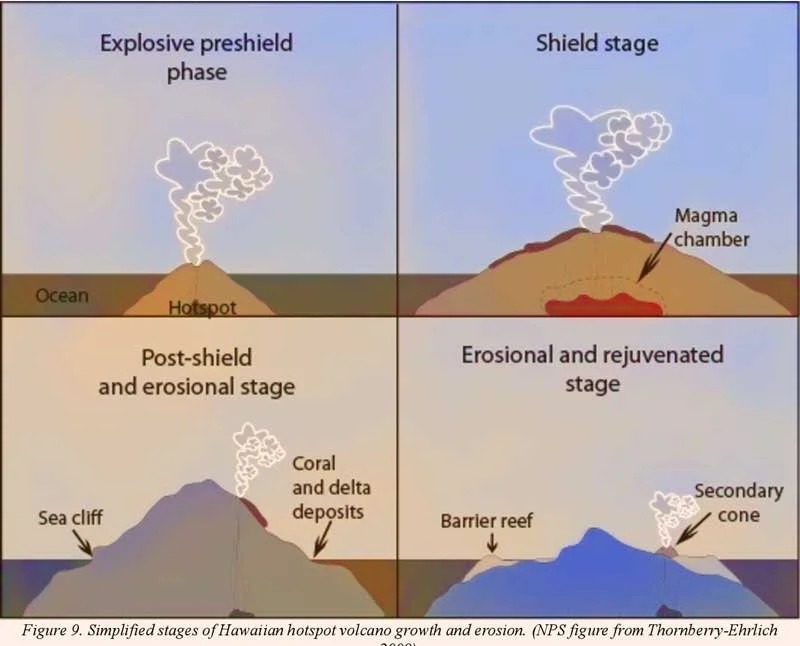
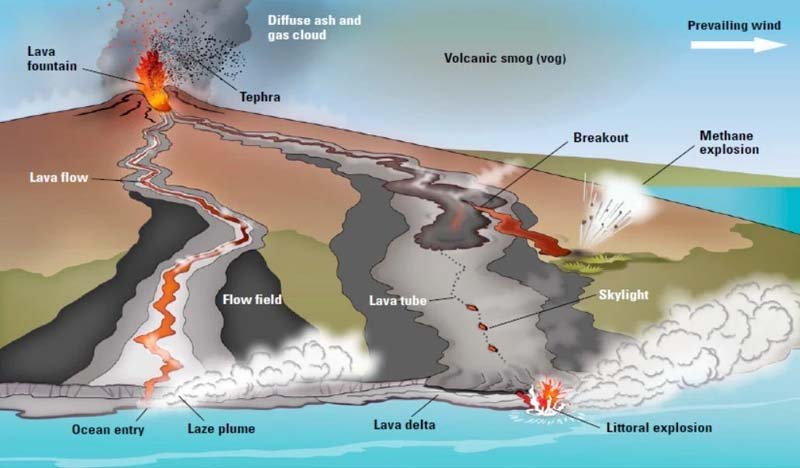
• Rift zone on Big Islandʻs Kilauea volcano
The “Crater” That Isn’t
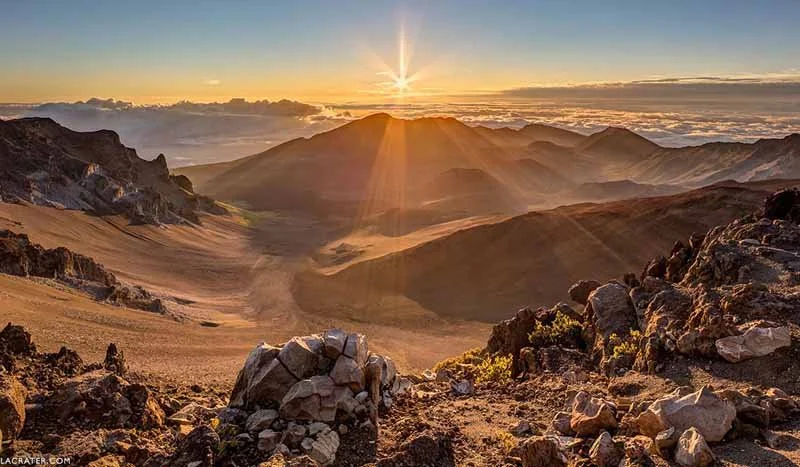
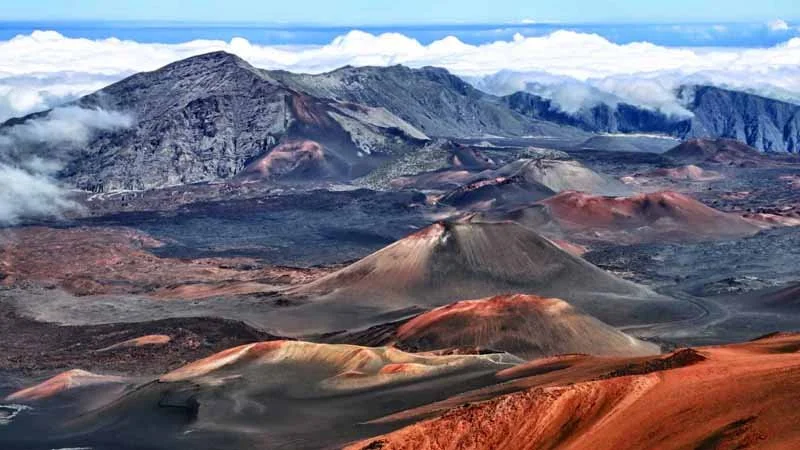
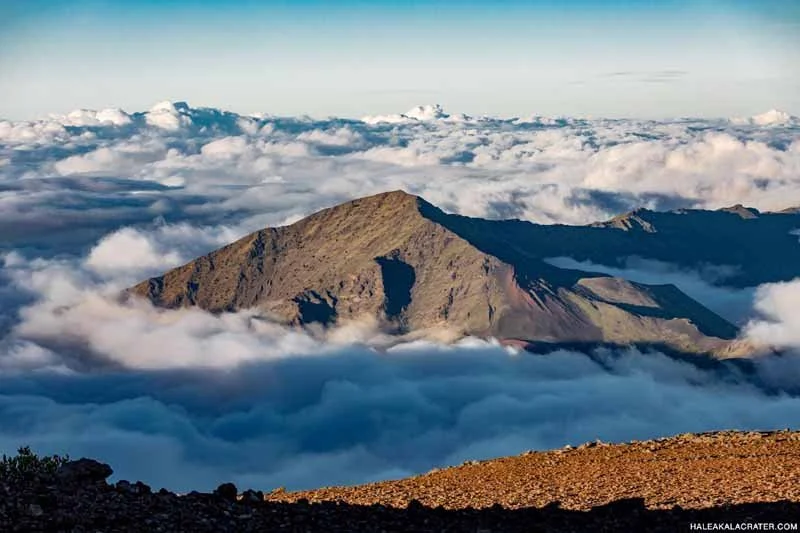
Most visitors look down into the enormous valley at Haleakalā’s summit and call it a crater.
Technically, that is not quite right.
The original circular summit crater eroded away long ago.
What you see today is a massive valley carved out by water and landslides over hundreds of thousands of years — not by a volcanic collapse.
• See FLANK ERUPTION on right hand side
About 145,000 years ago, lava flows formed a rim around the top of the volcano.
Rain, streams, and landslides then went to work, cutting two valleys into the mountain’s flanks.
Over time, those valleys merged into one, creating the deep, S-shaped basin visible today.
It is 3,000 feet deep at its lowest point and about 2.5 miles wide. At one point it was actually twice as deep, but later eruptions partially filled it back in with lava flows and cinder cones.
The rim of Haleakalā rises more than 2,500 feet above the valley floor in several places.
Cinder Cones & Lava Types
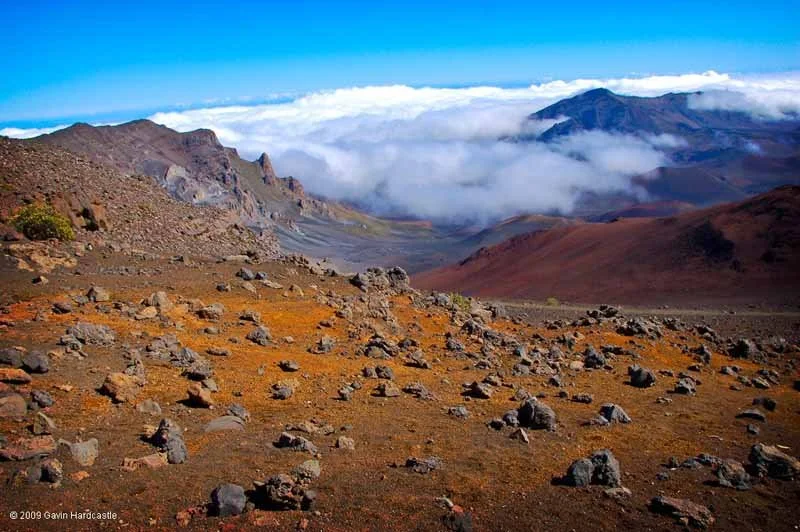
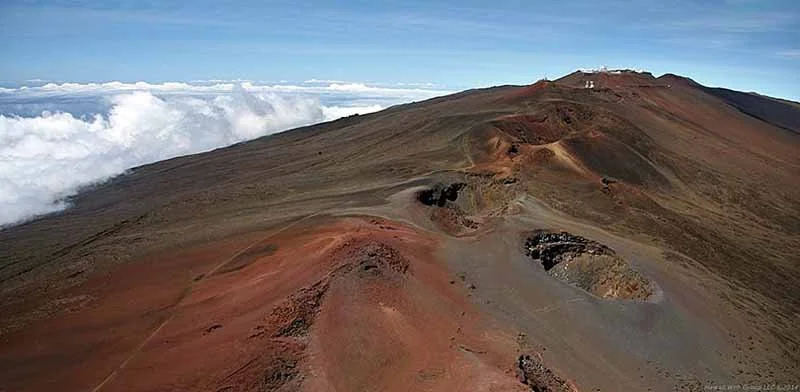
Dotting the floor of the summit valley are 14 multicolored puʻu — cinder cones.
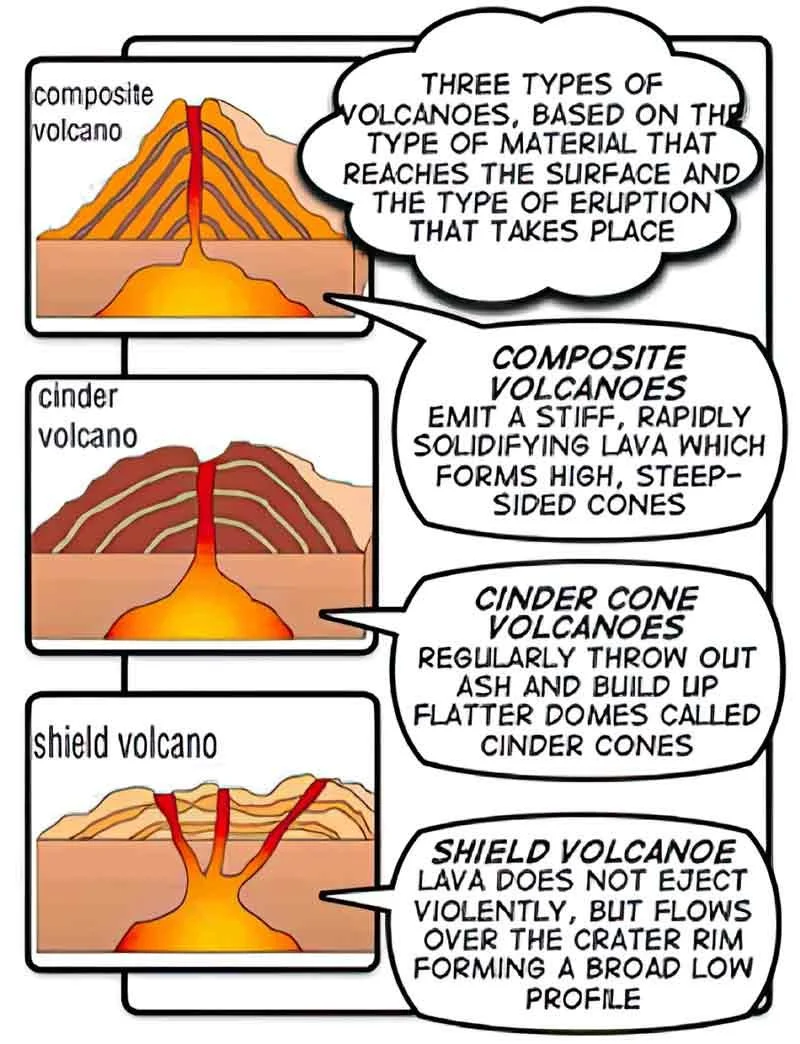
A puʻu forms when gas gets trapped in rising lava during an eruption. The pressure builds, and the lava shoots upward in a fountain.
This is similar to what happens when you shake a can of soda and then pop the top. The hot lava falls as sticky cinders around the base of the fountain, and over time those cinders pile up into a cone.
The different colors come from different minerals in the lava.
The lava on Haleakalā comes in two main types, and Hawaiian names for both are used by geologists all over the world.
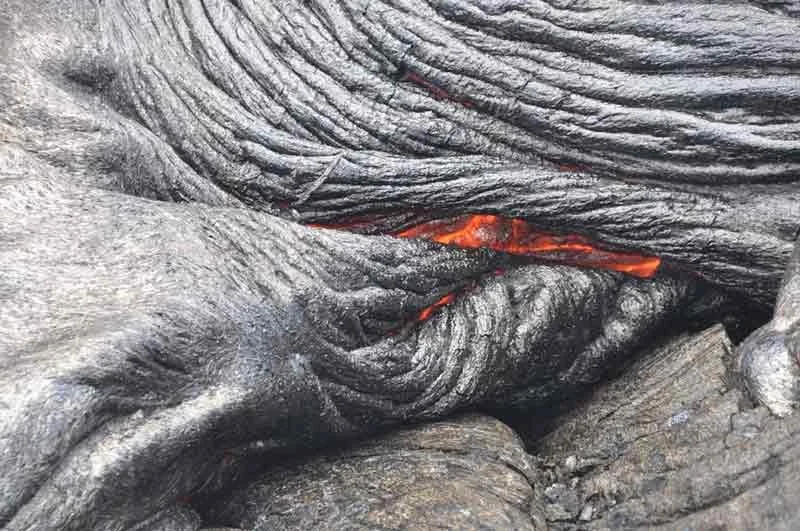
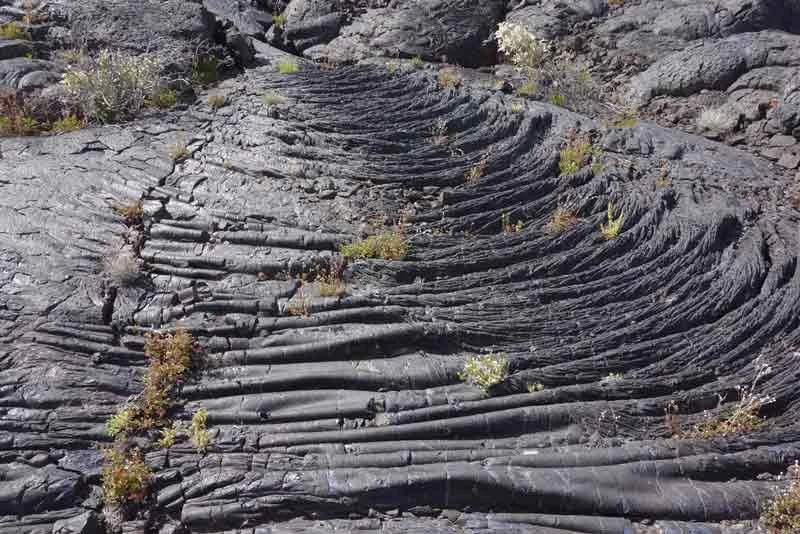
Pāhoehoe (pah-HOY-hoy) is hotter, flows more smoothly, and cools into ropy or wavy patterns on the surface. It is often a shiny blue-black color when it solidifies.
ʻAʻā (AH-ah) is cooler, thicker, and moves in a lurching, sludgy way. It cools into brown, crumbly, jagged chunks that crunch and clatter when you walk on them.
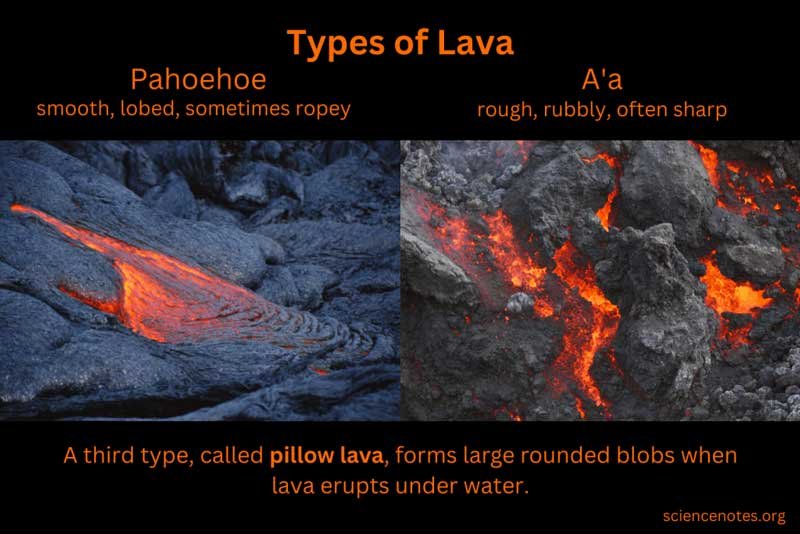
Temperature is the most important factor in deciding which type forms — though speed, gas content, and the direction of the flow also play a role.
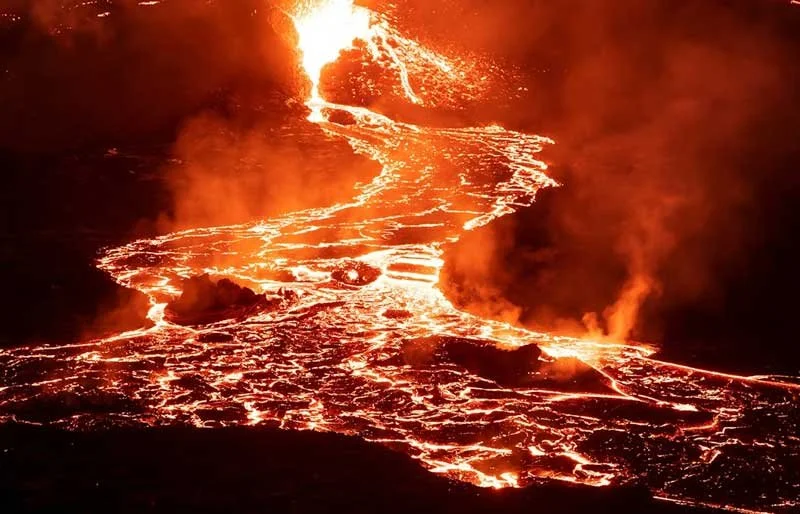
The word lava itself comes from Italian.
It originally described a stream of water rushing down from a sudden rainstorm, but when Mount Vesuvius erupted, people applied the same word to streams of molten rock.
Not Extinct — Just Resting
Here is something that might surprise you: Haleakalā is not extinct.
The last eruption on Maui happened only 400 to 600 years ago, along the southwest flank of the volcano near present-day Wailea. In the past 1,000 years, Haleakalā has erupted at least 10 times.
There is still debate about exactly when the most recent eruption occurred, with some estimates placing it in the late 1700s.
Right now, the volcano seems content to rest. But another eruption could happen within our lifetimes — or it could be 500 years or more from now.
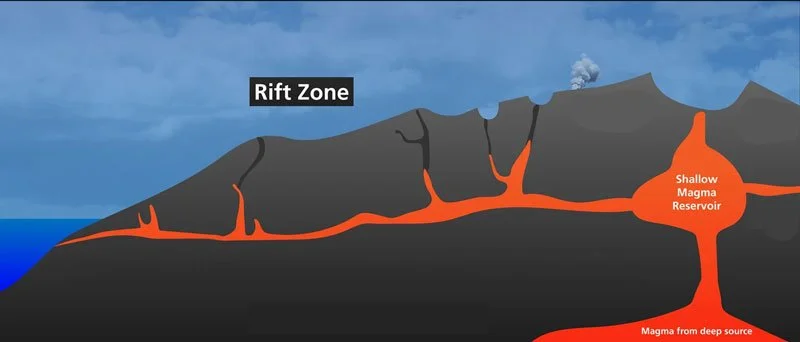
Those rows of puʻu visible from the town of Kahului mark the volcano’s rift zones, long lines of stress fractures where future eruptions could occur.
• The rejuvenated stage is F.
Haleakala Rising!
Between 1981 and 1992, satellites detected that Haleakalā actually rose about 0.23 feet per year.
Geologists think this may have been caused by magma moving deep underground, or by a kind of see-saw effect: constant eruptions on Hawaiʻi Island added weight and pushed that island down, which caused Maui to rise slightly in response — a bit like when someone sits on one end of a couch cushion and pushes the other end up.
Haleakalā is not done yet.

ʻAʻā (n.) — A type of Hawaiian lava that cools into rough, jagged, clinkery chunks; also a Hawaiian word meaning burning or glowing.
Basalt (n.) — A dark, fine-grained volcanic rock that makes up most Hawaiian lava flows.
Biosphere Reserve (n.) — An area officially recognized by the United Nations for protecting ecosystems while supporting scientific research and sustainable use of resources.
Cinder cone (n.) — A steep, cone-shaped hill built from lava fragments that fall around a volcanic vent during an eruption; called puʻu in Hawaiian.
Circumference (n.) — The distance around the outside of a circle or rounded object.
Erosion (n.) — The slow wearing away of rock and soil by water, wind, ice, or gravity.
Hot spot (n.) — A place deep inside the Earth where an unusually hot plume of rock melts through the crust and creates volcanic activity above it.
Igneous (adj.) — Describing rock that formed from cooled magma or lava; the word comes from the Latin word for fire.
Magma (n.) — Molten rock located beneath Earth’s surface; it becomes lava when it erupts.
Mantle (n.) — The thick layer of hot, semi-solid rock between Earth’s crust and its core.
Pāhoehoe (n.) — A type of Hawaiian lava that flows smoothly and cools into ropy or wavy patterns; a Hawaiian word combining pā (stone wall) and hoe (paddling a canoe).
Plate tectonics (n.) — The scientific study of the large, slow-moving slabs (plates) that make up Earth’s outer layer and whose movements cause earthquakes, volcanoes, and the formation of mountains.
Post-shield (adj.) — Describing the third stage of a Hawaiian volcano’s life, after the main shield-building phase, when eruptions become less frequent and the lava changes in composition.
Puʻu (n.) — The Hawaiian word for a cinder cone, a hill built from lava fragments ejected during a volcanic eruption.
Rift zone (n.) — A long line of fractures on the flank of a volcano where eruptions can occur as magma forces its way to the surface.

► COMPREHENSION QUESTIONS
— please answer with complete sentences
In what year was Haleakalā National Park designated a Biosphere Reserve?
Answer in a complete sentence.
Why do the Hawaiian islands form a long, long chain stretching from the south east to the north west?
Remember, many Hawaiian islands are uninhabited, eroded and sinking into the sea.
How do shield volcanoes form?
If Haleakalā is about 10,000 feet high, about how much higher was it in the past?
Answer in a complete sentence.
If Haleakalā is about 10,000 feet high above sea level, about how much higher is it if measured from the ocean floor?
Answer in a complete sentence.
What are the four stages of volcanic growth and what stage is Haleakalā in?
Is Haleakalā a crater? Why or why not?
How do puʻu (cinder cones) form?
Be sure to read the text AND look at the illustration below it.
What is the difference between pāhoehoe and ʻaʻā lava?
Explain why Haleakalā is rising?
ABCD (Above & Beyond the Call of Duty) — the only way to get to 50/50 (A+); you may need the points if you’ve dropped points above.
Watch the short video below about hotspots.
Note two things you learned about hotspots that you didnʻt already know.
Dr. Kirtland Peterson Cat Peterson Dr. Cat